

Recommendations: Evidence-Based Proposals for Improvement
These recommendations are ordered from what a school nurse can start now to what takes district and health-system partnership. Together they move us from paper hand-offs toward real health information exchange.
Recommendation 1
Establish read-only EHR access for school nurses through a community health-system partnership
- MPS health services partners with a local health system or large pediatric practice to give school nurses view-only portal access for consented students with chronic conditions.
- Start with a pilot group: students with asthma, type 1 diabetes, seizure disorders, and severe allergies.
- Access is role-based, limited to students on each nurse's caseload, and audited by the health system.
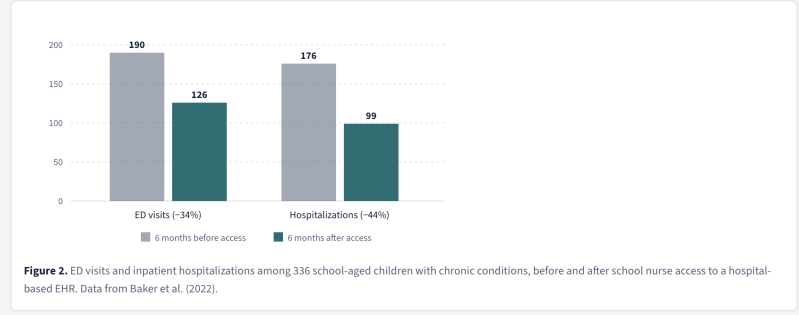
Evidence: In a study of 336 students with chronic conditions, ED visits dropped from 190 to 126 (34%) and hospitalizations dropped from 176 to 99 (44%) in the six months after school nurses received hospital EHR access (Baker et al., 2022).
Recommendation 2
Add a secure two-way messaging channel between school nurses and primary care providers
- Use the health system's secure messaging or referral portal so a school nurse can send an assessment ("3 rescue inhaler uses this week") and receive updated orders without fax.
- Set an ED/discharge notification for consented students so the school is told when a student was seen, instead of finding out from the child.
Evidence: Reeves et al. (2016) built an EMR-based communication process between school nurses and primary care providers for 33 students previously hospitalized for asthma. The pilot proved feasible, and hospital admissions decreased among students whose school nurse communicated through the EMR.
Recommendation 3
Use ImmPRINT to its full capacity for immunization compliance
- Assign every new and transfer student in ImmPRINT at enrollment, using manual assignment for unmatched students since it's more accurate than bulk matching (ADPH, 2025).
- Run COI Action Reports at set points (start of year, end of each grading period) instead of chasing paper certificates one at a time.
- Enter historical vaccines for assigned students when documentation is verified, which the ADPH manual notes school nurses are allowed to do.
Evidence: ADPH (2025) reports that bulk student-list uploads match only about 50% of students automatically, so a consistent enrollment-time workflow closes the biggest gap in this already-interoperable system.
PRecommendation 4
Standardize school health documentation so it's "exchange-ready"
- Replace free-text where possible with structured fields in PowerSchool: diagnoses, medication name/dose/route/time, action-plan type, and visit outcomes (returned to class, sent home, 911).
- Adopt standardized nursing language and data points recommended by NASN, so data can be shared and trended.
- Have a school nurse represent health services on the district technology committee when EHR or student information system changes are evaluated.
Evidence: NASN (2024) calls EHRs an essential school nursing tool and recommends documentation that uses standardized nursing language and data points, can exchange data with community records, and includes school nurses on district IT committees for decisions about usability and interoperability.
Recommendation 5
Build the privacy and consent framework first
- Create one plain-language parent authorization at registration that covers both FERPA and HIPAA, so the school and providers can share information both ways.
- Write a data-sharing agreement that spells out minimum necessary access, role-based logins, audit logs, and what happens when a nurse leaves or changes schools.
- Train nurses on the agreement and document consent status in the school record.
Evidence: Baker and Gance-Cleveland (2021) identify legal and logistical considerations as central barriers to school nurse EHR access, and NASN (2024) calls for school health EHRs to protect confidentiality and keep audit logs of changes.
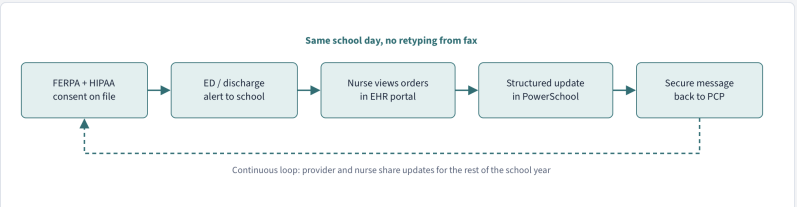
Figure 3. Proposed future-state process map after Recommendations 1,2,4 and 5.

Implementation and Evaluation
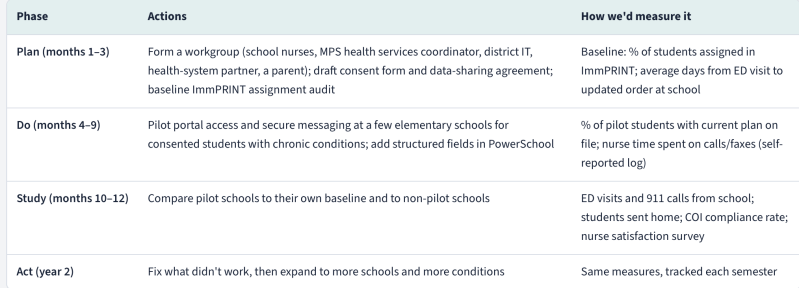
I'd roll this out using Plan-Do-Study-Act (PDSA) cycles so we learn from a small pilot before scaling up across the district.
Create Your Own Website With Webador